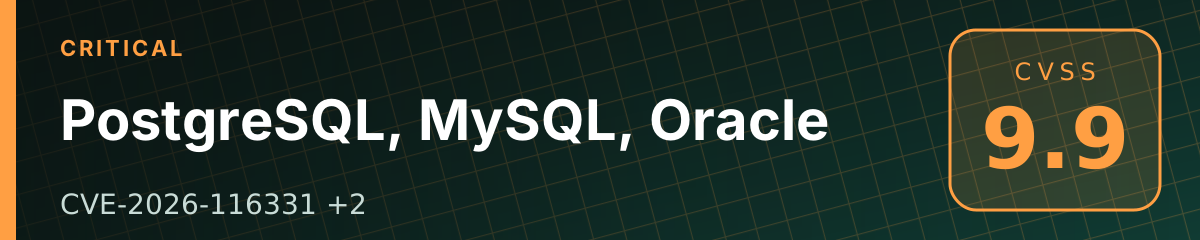
Critical CVSS 9.9 Security news
An account with no access to data is enough to run code on PostgreSQL, MySQL and Oracle servers, depthfirst research shows
On 18 November 2026 Zheng Yu of depthfirst published research showing how a database account with minimal privileges, unable to read a single application table, can run code on the server as the database service account. He demonstrated it on PostgreSQL, MySQL, Oracle and ClickHouse. The first three vendors have already shipped fixes: PostgreSQL on 12 November, MySQL in October and Oracle on 17 November. No in-the-wild exploitation has been reported.
Key points
- The research: SQL grants limit access to data, not to the database engine's native code. Even a minimal account can reach bugs in the query planner, aggregates or wire protocol.
- PostgreSQL CVE-2026-116331 (CVSS 8.8): the default TEMPORARY privilege every account has is enough. Fixed on 12 Nov in 18.7, 17.12, 16.16, 15.20 and 14.25.
- Oracle fixed MySQL CVE-2026-101786 (out-of-bounds write in the windowed BIT_OR function) on 20 Oct and Oracle Text CVE-2026-114819 (CVSS 9.9) on 17 Nov; the researcher chained the latter with GraphQL flaw CVE-2026-91609 for an unauthenticated attack.
- What to do: patch, narrow temporary-table privileges and stop assuming a low-privilege account cannot endanger the server.
Vulnerabilities: CVE-2026-116331, CVE-2026-101786, CVE-2026-114819
What happened
On 18 November 2026 Zheng Yu, a security researcher at depthfirst, published a write-up called "Narrow Grants, Wide Engines". It shows that a database account with minimal privileges, one that cannot read a single application table, can run code on the server as the account the database runs under. He demonstrated this on PostgreSQL, MySQL, Oracle Database and ClickHouse.
His core argument: SQL grants protect logical objects such as tables and views. But every permitted statement still passes through the engine's native C and C++ code, from the query planner to the wire protocol. A memory-corruption bug in that code therefore bypasses even tightly scoped privileges. As the researcher puts it, a short SHOW GRANTS output does not mean a small native attack surface.
The PostgreSQL, MySQL and Oracle vendors fixed their bugs before the research went public. No in-the-wild exploitation had been reported as of 19 November.
Technical details
- PostgreSQL - CVE-2026-116331 (CVSS 3.0 8.8). According to PostgreSQL, this is a type confusion in the min/max aggregate optimisation. The attacker creates a user-defined aggregate with a
SORTOPoption, and the planner then treats its input and result as the same type when they are not. According to depthfirst, a default login role with no extra grants is enough, because accounts get theTEMPORARYdatabase privilege by default. - MySQL - CVE-2026-101786 (CVSS 3.1 7.2). An out-of-bounds write in the windowed
BIT_ORfunction in the optimiser: the result size is fixed when the statement is prepared, but the real length is only known at execution time. Oracle rates it as exploitable only with high privileges; the researcher ran code from an account withCREATE TEMPORARY TABLES ON *.*and no right to read tables. - Oracle Database - CVE-2026-114819 (CVSS 3.1 9.9). A flaw in the Oracle Text component, which Oracle rates as exploitable with low privileges, per NVD. The researcher chained it with GraphQL interface flaw CVE-2026-91609 (fixed by Oracle in October) into an unauthenticated attack through an exposed HTTP endpoint.
- ClickHouse - no CVE. An integer wraparound in the RowBinary string deserialiser leads to a heap overflow. It needs the
CREATE TEMPORARY TABLE ON *.*privilege and the default configuration, which lets an HTTP caller setformat_binary_max_string_size=0.
We are deliberately not reproducing exploit details here.
Who is affected
- PostgreSQL, every version before 18.7, 17.12, 16.16, 15.20 and 14.25.
- MySQL Server and MySQL Cluster 26.7.0-26.7.1 (per NVD).
- Oracle Database Server, the Oracle Text component in 19.3-19.32, 21.3-21.24 and 23.4.0-23.26.3 (per NVD).
- ClickHouse: the researcher tested 26.7.5.10-stable; no fixed version is confirmed.
The highest risk is on servers shared by several applications or people (shared hosting, analytics platforms, internal BI) and behind applications exposed to SQL injection, because that is exactly the kind of "small" account an attacker ends up with.
How to tell if you were compromised
Neither the vendors nor the researcher have published indicators of compromise, and nobody has documented exploitation in the wild. We suggest watching for:
- database process crashes and memory-corruption messages in the server log (PostgreSQL: a backend terminated by signal 11),
- in PostgreSQL, new user-defined aggregates (
CREATE AGGREGATE) from application accounts that would not normally create them; enable DDL logging (log_statement = 'ddl'), - shells or network connections started under the
postgres,mysql,oracleorclickhouseaccount.
What to do
- Patch: PostgreSQL to 18.7, 17.12, 16.16, 15.20 or 14.25 (released 12 November); MySQL per Oracle's October advisory; Oracle Database per the November Security Patch Update, and ORDS per its October release.
- Narrow temporary-object privileges. In PostgreSQL remove the default grant with
REVOKE TEMPORARY ON DATABASE <db> FROM PUBLIC;and grant it only to accounts that need it. In MySQL and ClickHouse, don't hand outCREATE TEMPORARY TABLE(S) ON *.*to accounts that don't need it. - Keep database interfaces off the internet (Oracle and ClickHouse HTTP endpoints, ports 5432 and 3306).
- Treat the application account as a possible way onto the server. Isolate the database server from other systems and restrict where it can connect.
Timeline
Update
- 19 Nov 2026: first version.
FAQ
Our application only has a read-only database account. Are we safe?
Not necessarily. The research shows exactly that no data access is needed: in PostgreSQL the TEMPORARY privilege that accounts get by default is enough, and in MySQL and ClickHouse the right to create temporary tables. If an attacker takes over the application, for example through SQL injection, such an account can be used to take over the whole database server. So patch.
Is managed PostgreSQL in the cloud affected?
It depends on the version your provider runs. Managed services such as Amazon RDS, Azure and Google Cloud SQL usually roll out minor releases themselves during maintenance windows. Check the version with SELECT version(); and schedule the upgrade yourself if needed.
What about ClickHouse?
The researcher describes an integer wraparound in the RowBinary string deserialiser that leads to a heap overflow. The write-up lists no CVE or fixed version; he tested 26.7.5.10-stable. Watch ClickHouse's security notes and restrict the CREATE TEMPORARY TABLE privilege.
Sources
- depthfirst - Narrow Grants, Wide Engines: Reaching Native Database Attack Surface from Minimal SQL Roles (18 Nov 2026)
- PostgreSQL - CVE-2026-116331: min/max aggregate type confusion executes arbitrary code (12 Nov 2026)
- NVD - CVE-2026-101786 (MySQL Server, Optimizer)
- NVD - CVE-2026-114819 (Oracle Text in Oracle Database Server)
- Oracle - Security Patch Update, November 2026
- MySQL - security advisories, 20 Oct 2026
Spotted a mistake? Let us know and we will correct it openly.
Related
Actively exploited
VMware vCenter CVE-2026-123890: critical authentication bypass exploited as a zero-day by a China-nexus group
On 19 November 2026 Broadcom published VMSA-2026-0009, fixing CVE-2026-123890, a critical flaw in VMware vCenter (CVSS 9.8) that lets an attacker with network access log in as the vSphere administrator without a password. Broadcom says nothing about attacks, but on the same day Google Threat Intelligence Group (GTIG) and Mandiant showed that ARMORY CASTLE, a suspected China-nexus group, was already exploiting it in early September 2026 – and used vCenter to reach data inside other virtual servers.

Patch available
Drupal fixes a critical installer flaw: install.php can be abused to take over a site
On 18 November 2026 the Drupal Security Team released a fix for SA-CORE-2026-017 (CVE-2026-132165), a critical flaw in the installer. Under specific conditions an unauthenticated attacker can use install.php to attempt a reinstall of Drupal, leading to site takeover or code execution on the server. The advisory says a proof of concept exists. Fixed releases are 11.4.13, 11.3.22 and 10.6.22; if you can't upgrade right away, block the installer at the web server.
Actively exploited
Apache Axis 1.x flaw CVE-2026-90436 is under attack, and no fixed release is coming
On 18 November 2026 CISA added CVE-2026-90436 to its Known Exploited Vulnerabilities (KEV) catalog. The flaw sits in Apache Axis 1.x, an old Java library for SOAP web services. A crafted SOAP fault makes Axis load and instantiate an attacker-chosen class before any authentication check, which can lead to code execution (CVSS 9.8). Axis 1.x is end-of-life and the project will not ship a fixed release. Since 12 November attackers have been exploiting it in N-able N-central servers to install cryptominers.