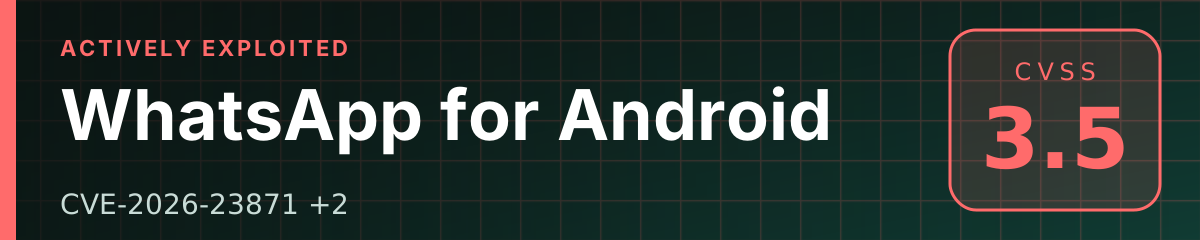
Actively exploited CVSS 3.5 Security news
WhatsApp for Android: a crafted ad-reply message could reveal your IP address to an attacker
On 20 November 2026 WhatsApp published its November security advisories. CVE-2026-23871 in WhatsApp and WhatsApp Business for Android let an attacker learn a recipient's IP address through a crafted message tied to a Click to WhatsApp ad. The severity is low, but WhatsApp says it may have been abused alongside spam - according to a spokesperson, in a scam campaign. Updating the app fixes it.
Key points
- CVE-2026-23871 (CVSS 3.1: 3.5): WhatsApp for Android did not fully validate media URLs in Click to WhatsApp ad replies, so simply rendering the message revealed the device's IP address to the attacker.
- WhatsApp's security team found the flaw while disrupting a scam campaign; the company believes it was used to make scam messages look more credible.
- Fixed in 2.26.17.4. The same update fixed CVE-2026-102769 (SQL injection via an 'order details' message) and CVE-2026-44908 (Private Processing attestation), neither known to be exploited.
Vulnerabilities: CVE-2026-23871, CVE-2026-102769, CVE-2026-44908
What happened
On 20 November 2026 WhatsApp added a November update with three vulnerabilities to its security advisories page, and the records appeared in the NVD the same day. The most notable is CVE-2026-23871 in WhatsApp and WhatsApp Business for Android: a crafted message could reveal the recipient's IP address to an attacker.
Meta, which assigns CVE IDs for WhatsApp, rates it low (CVSS 3.1: 3.5). What matters is the extra line in the advisory: the flaw may have been abused in conjunction with specific spam messages. A WhatsApp spokesperson told SecurityWeek that the team found the issue while disrupting a scam campaign, and that the company believes a scammer used it to make messages seem more credible.
| CVE | CVSS 3.1 | What it does | Exploitation |
|---|---|---|---|
| CVE-2026-23871 | 3.5 | IP address leak via an ad reply | possible (per WhatsApp) |
| CVE-2026-102769 | 6.8 | SQL injection via an "order details" message | none seen |
| CVE-2026-44908 | 4.8 | incomplete certificate chain check in Private Processing | none seen |
Technical details
CVE-2026-23871. Businesses can run "Click to WhatsApp" ads on Facebook and Instagram that open a chat with the business when tapped. According to the advisory, WhatsApp did not fully validate external URLs in replies linked to such ads. An attacker could put media - an image, for example - hosted on a server they control into a crafted ad-reply message. When the message rendered in the chat, the phone fetched the media directly from that server, and the attacker saw the victim's IP address in their logs.
The CVSS vector (AV:N/AC:L/PR:L/UI:R) describes a network attack that needs the attacker's own account and requires the victim to open the chat. Impact is limited to low confidentiality: no message content and no control of the device. An IP address does, however, give away approximate location and provider, which is useful to scammers - a message that mentions "your" city feels like it comes from someone who knows you.
CVE-2026-102769. According to the NVD, this SQL injection was triggered when a recipient opened a crafted "order details" message sent from an unofficial client. It could delete locally stored WhatsApp files and, if the recipient was online, leak a single bit of chat database information through a timing side channel. An external researcher reported it through Meta's bug bounty programme.
CVE-2026-44908. The remote-attestation verifier that the app uses to establish trust with the servers behind WhatsApp Private Processing (confidential processing for Meta AI) did not properly validate the certificate chain. Someone positioned inside Meta's infrastructure could have presented a VCEK certificate not signed by the hardware manufacturer's key. Any such certificate would have had to appear in a third-party binary transparency ledger, and Meta says the ledger contains none.
Who is affected
- CVE-2026-23871: WhatsApp and WhatsApp Business for Android from 2.20.198.3 up to, but not including, 2.26.17.4.
- CVE-2026-102769: WhatsApp and WhatsApp Business for Android from 2.22.3.7 up to, but not including, 2.26.35.74.
- CVE-2026-44908: WhatsApp for iOS (before 2.26.24.72), WhatsApp Business for iOS and WhatsApp for Mac (before 2.26.23.72), WhatsApp for Android (before 2.26.23.74) and WhatsApp Business for Android (before 2.26.23.70).
If you have automatic updates enabled in Google Play or the App Store, you most likely already have the fixes.
How to tell if you were compromised
WhatsApp has not published indicators of compromise, and an IP address leak leaves no trace on the phone. Watch for a message from an unknown account that looks like a business replying to an ad, contains an image and is quickly followed by a job, investment or prize offer - often hinting at where you are. The message itself does not endanger your account, but it is a classic opening for a scam.
What to do
- Update WhatsApp on every device. Check the version under Settings → Help → App info.
- Don't reply to unsolicited offers from unknown numbers, even if the message looks like an ad reply or knows your city.
- Check links from suspicious messages with our Link checker.
- If someone has taken over your account, follow our guide Hacked WhatsApp account: what to do.
Organisations managing work phones through MDM should enforce WhatsApp for Android 2.26.35.74 or later.
Timeline
- date not given – WhatsApp's security team found the flaw while acting against a scam campaign; the advisory gives no fix date, and 2.26.17.4 is the first fixed version.
- 20 Nov 2026 – WhatsApp published its November advisory update; all three CVE records appeared in the NVD.
FAQ
What can an attacker learn from my IP address?
Your approximate location (often just the city or region) and your internet or mobile provider. A scammer can use that to make a message feel personal. It does not give access to your account, chats or phone.
Does this affect iPhone?
According to WhatsApp, CVE-2026-23871 affects only the Android apps. CVE-2026-44908, however, also affects WhatsApp for iOS and Mac, so update everywhere.
How do I check my WhatsApp version?
Open Settings → Help → App info. If you don't see 2.26.17.4 or later, update from Google Play.
Sources
Spotted a mistake? Let us know and we will correct it openly.
Related
News
Italy fines Meta €805 million after Facebook for Android accessed users' photo galleries without valid consent
Italy's data protection authority, the Garante, announced on 14 November 2026 an €805 million fine against Meta Platforms Ireland. A Facebook for Android feature that suggests gallery photos and videos as post ideas accessed photos and their metadata for about 20 million Italians without specific consent, and it was switched on by default, the regulator found. Meta plans to appeal.
News
Italy fines Meta €805 million over Facebook for Android accessing photo galleries without consent
On 14 November 2026 Italy's data protection authority, the Garante, fined Meta Platforms Ireland €805 million. A feature in the Facebook app for Android that suggests photos and videos from the phone's gallery while you browse accessed device content without specific consent, the regulator found. Here is what the Garante decided, why it matters beyond Italy, and how to check and switch off Facebook's access to your gallery.
News
Signal blocks screenshots to stop AI assistants in iOS 27 and Android from reading private chats
On 20 November 2026 Signal announced it is restricting the AI agents built into mobile operating systems. On iOS 27 it blocks in-app screenshots because Siri can now read what is on screen, and on Android it turns on screen security when it detects an AI assistant trying to read the display. Signal is upfront that this is incomplete: there are other ways to reach data on a phone than a screenshot.