News Security news
myColorado: attacker reached ID documents uploaded to the state app, about 100,000 affected
Colorado has kept its myColorado app offline since 18 November 2026. About 2.1 million people use it for a mobile driver license and state services. The state has now confirmed on the app's website that an intruder accessed mainly files users had uploaded to the "myCards and Documents" section, such as photos and PDFs of passports, vehicle registrations and insurance cards. Roughly 100,000 people are affected.

Key points
- According to the myColorado website (update of 25 Nov), automated threat detection in the state's AWS environment flagged unusual activity late on 18 Nov and the app was taken offline.
- The intruder mainly reached files uploaded to "myCards and Documents" (passports, vehicle registrations, insurance cards); payment information was not involved.
- About 100,000 users are affected; notices listing each person's documents are due to start on 27 Nov. There is no restoration date.
The State of Colorado has now confirmed on the myColorado website (latest update 25 November 2026) what earlier came only from media reports: an intruder gained access to user data. The app remains offline and the state has no restoration date.
What the state has confirmed
- Detection: late on 18 November, automated threat detection in the state's AWS environment flagged unusual usage. The Office of Information Technology (OIT) security team found signs of unauthorised activity and took the app offline to contain it.
- What data: mainly files people uploaded themselves to the "myCards and Documents" section: PDFs and photos of items such as passports, vehicle registrations and insurance cards. The state says payment information was not involved.
- How many people: roughly 100,000 of about 2.1 million users. The state is still matching documents to individuals, so the figure may change. (On 24 Nov, media quoted an OIT estimate of 50,000 to 150,000.)
- Notification: affected users will be contacted directly, with a list of the specific documents involved. Notices are due to start on Friday 27 November.
- The state says it has no reason to believe the incident is part of a wider attack.
The state has not said how the intruder got in, who is responsible or whether it will offer credit monitoring.
What to do now
- Passwords: if you used the same password or email for myColorado as elsewhere, change those passwords, starting with email, banking and your mobile carrier. Use unique passwords (a password manager helps) and two-step verification, ideally an authenticator app or a passkey. Our Password generator creates strong ones.
- Accounts and credit: review bank and card statements; if you spot a suspicious charge, call the number on the back of your card, not one from an email or text. The state recommends a free credit freeze with Equifax, Experian, TransUnion and Innovis.
- Scam messages: stolen photos of ID documents make convincing lures in messages posing as the state. Don't open "breach" links; check status directly at mycolorado.gov, and vet a suspicious link with our Link checker.
- Documents: use your physical license for air travel and ID checks. If you uploaded a passport, follow the guidance in your notice on whether to replace it.
Why it matters beyond Colorado
Apps that store photos of ID documents are a rich target: a single breach hands fraudsters material for account takeover and loan applications. If you keep pictures of your passport or ID card on your phone or in apps, ask whether they really need to be there. Our guide Data breach: what to do covers the next steps after your details leak.
Update
26 Nov 2026: Upgraded from Reported to Verified. The myColorado website (25 Nov update and FAQ) confirms unauthorised access to uploaded documents, about 100,000 affected users and notices starting on 27 Nov. We have rewritten the story from the state's own statement; the earlier media figures (50,000 to 150,000) are noted above.
24 Nov 2026, 22:00 UTC: According to The Record, OIT said the attack likely involved data tied to nearly 150,000 people.
Sources
Spotted a mistake? Let us know and we will correct it openly.
Related

News
Google tightens the rules for Workspace AI agents: MCP servers or CLI only from 1 February 2027, with separate identities and human approval
On 25 November 2026 Google announced a set of security controls for AI agents that work with data in Google Workspace and Google Cloud. Agents will have to use new MCP servers or the Workspace CLI instead of the regular REST APIs, run under their own OAuth client, and ask a person before sending email or changing sharing. Here is what it means for admins and developers.
Actively exploited
Fake take-home tests: 13 malicious NuGet packages target .NET developers on Windows
A job candidate receives a take-home assignment: a WinUI 3 project to improve in a few hours. The very first build quietly pulls malicious code from GitHub. On 23 November 2026 Socket researchers described a campaign built on 13 NuGet packages, a Chrome profile stealer and command and control over GitHub and Telegram.
Actively exploited
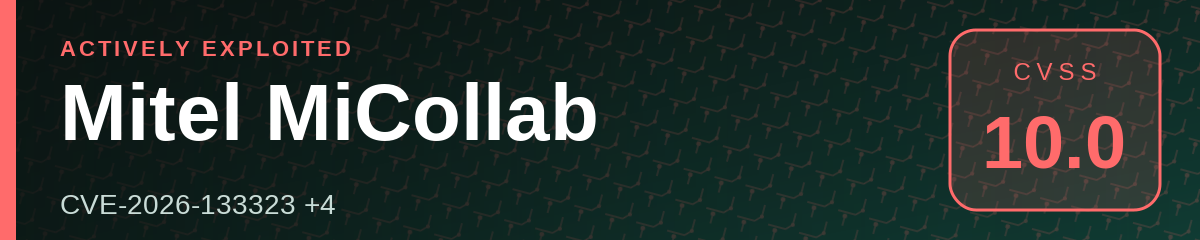
Mitel MiCollab: five AWV conferencing flaws exploited, attackers pivoted from the server into Active Directory
On 25 November 2026 CISA added five vulnerabilities in the Mitel MiCollab unified communications platform to its Known Exploited Vulnerabilities (KEV) catalog. All five sit in the Audio, Web and Video Conferencing (AWV) component and need no authentication. Mitel fixed them on 16 November, but according to Accenture attackers were already exploiting them the day before, and went on from the compromised server to domain controllers and databases.