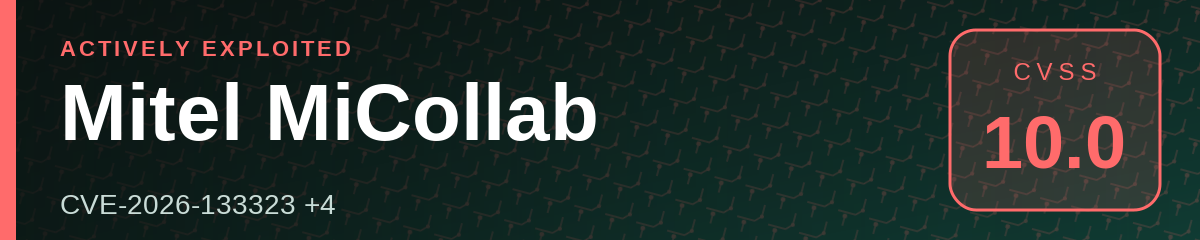
Actively exploited CVSS 10.0 Security news
Mitel MiCollab: five AWV conferencing flaws exploited, attackers pivoted from the server into Active Directory
On 25 November 2026 CISA added five vulnerabilities in the Mitel MiCollab unified communications platform to its Known Exploited Vulnerabilities (KEV) catalog. All five sit in the Audio, Web and Video Conferencing (AWV) component and need no authentication. Mitel fixed them on 16 November, but according to Accenture attackers were already exploiting them the day before, and went on from the compromised server to domain controllers and databases.
Key points
- Mitel published advisory MISA-2026-0012 on 16 Nov 2026 for five flaws in the AWV component of MiCollab 10.3 (10.3.0.18) and earlier. CVE IDs followed on 24 Nov, and CISA added all five to KEV on 25 Nov.
- The worst is an unauthenticated command injection (CVE-2026-133323, CVSS 10.0 per Mitel, 9.8 per NVD), followed by an XML injection (CVE-2026-133303, CVSS 9.0). Mitel rates the other three – authentication bypass, file upload and unauthorised access – as medium, but says chaining them significantly amplifies the impact.
- Accenture APEX Labs describes an intrusion that went from a web shell to root, stole the LDAP connector credentials, ran Kerberoasting, exported Active Directory users and exfiltrated a database within 23 hours.
- US federal agencies must fix the flaws by 28 Nov (CVE-2026-133311 by 9 Dec). Indicators of compromise are listed below, ready to copy.
Vulnerabilities: CVE-2026-133323, CVE-2026-133303, CVE-2026-133311, CVE-2026-133275, CVE-2026-133324
What happened
On 25 November 2026 the US agency CISA added five flaws in Mitel MiCollab to its Known Exploited Vulnerabilities (KEV) catalog. Organisations use MiCollab for voice, messaging and conferencing. All five flaws are in the AWV (Audio, Web and Video Conferencing) component and all of them work without authentication.
Mitel had already fixed them on 16 November in advisory MISA-2026-0012 and added CVE IDs on 24 November. According to Accenture APEX Labs, however, attackers were exploiting the flaws before the fix: on one server they found web-shell activity before 23:00 UTC on 15 November. A second MiCollab server had been beaconing to the same attacker infrastructure since 9 November. Accenture assesses this as a broader campaign, possibly data theft and extortion.
Technical details
Mitel lists the following flaws (all in AWV, CVSS 3.1 as scored by Mitel):
| CVE | Flaw type | CVSS |
|---|---|---|
| CVE-2026-133323 | blind command injection | 10.0 (NVD 9.8) |
| CVE-2026-133303 | XML injection | 9.0 |
| CVE-2026-133311 | unauthorised access to sensitive information | 5.9 |
| CVE-2026-133275 | arbitrary file upload | 5.3 |
| CVE-2026-133324 | authentication bypass | 5.3 |
According to NVD, CVE-2026-133323 lets an unauthenticated attacker run operating system commands with system privileges. Mitel explicitly says that exploiting the flaws together significantly amplifies their impact, so don't dismiss the three "medium" ones.
Accenture describes how the attack on the confirmed victim unfolded (times from the first request):
The attacker exfiltrated data in hundreds of short HTTPS uploads, partly routed through an internal backup server and a temporary Cloudflare tunnel.
Who is affected
Anyone running Mitel MiCollab 10.3 (10.3.0.18) or earlier. Servers whose AWV component is reachable from the internet are most at risk, including through the MiVoice Border Gateway web proxy – Accenture says it did not stop exploitation. The second victim ran an even older 10.0-series release that was also vulnerable to the flaws in the earlier advisory MISA-2026-0006.
How to tell if you were compromised
Accenture APEX Labs published the indicators below (defanged – replace [.] with . before loading them into tools). No file hashes were published.
# Attacker IP addresses
204.76.203[.]204   (hunt from 2026-11-06)
204.76.203[.]216   (hunt from 2026-11-12)
# Domains
204-76-203-204.sslip[.]io
freeware-peter-desktop-parker.trycloudflare[.]com
# URLs
hxxps://204[.]76[.]203[.]204/bkup/   (exfiltration, HTTP PUT → 201)
hxxps://204[.]76[.]203[.]204/bkdl/   (tool downloads)
# TLS certificate fingerprint (SHA-256)
df2184dda5ca97d0c8589640ac1eb9392dfab8cc990f51949099ce757f47397f
# Web paths
/pictures/*/shell.asp?c=   (shell.jsp was also tried)
POSTs to /awcuser/cgi-bin/ from unfamiliar sources, followed by new files under /pictures/
# Files in /tmp
roast*.py  mkccache.py  testcreds.py  testcreds2.py  relay_one.exp  relay.py  *_batch_*.tgz
# User agent
curl/8.14.1
What else to check:
- proxy, gateway and WAF logs, not just local logs – the attacker cleaned logs on the server, and system logs that suddenly shrink are a red flag,
- tools on the MiCollab server that don't belong there: smbclient, ldapsearch, Impacket, sshpass,
- the LDAP connector account – logons to many domain controllers or bursts of RC4 Kerberos service-ticket requests,
- outbound traffic from MiCollab and Border Gateway servers to unfamiliar hosts, trycloudflare.com domains and IP-echo services.
Our IOC extractor pulls addresses and domains out of logs, and the CVSS calculator breaks down the scores. Both run entirely in your browser.
What to do
- Apply the fix for MiCollab 10.3 (10.3.0.18) following Mitel KB000129195, or move to a later release. On older versions, upgrade to 10.3.0.18 first.
- Restrict internet access to AWV, including the path through MiVoice Border Gateway – Mitel's mitigation for anyone who can't patch right away.
- Take forensic images of MiCollab and Border Gateway servers before patching or rebuilding, and check them against the indicators above.
- If you suspect a compromise, reset the LDAP connector account and Kerberoastable service accounts, review the connector's logons on every domain controller, and rotate administrator, SIP trunk and file-share credentials reachable from the server.
- Also fix the older exploited MiCollab flaws (CVE-2024-41713, CVE-2024-55550) and those in MISA-2026-0006.
Timeline
- 6 Nov 2026 – earliest recommended hunt date for 204.76.203[.]204 (Accenture).
- 9 Nov 2026 – a second MiCollab server starts beaconing to attacker infrastructure.
- 15 Nov 2026 – web-shell activity on the confirmed victim, a day before the patch.
- 16 Nov 2026 – Mitel publishes MISA-2026-0012 and the fix.
- 19 Nov 2026 – CVE records appear in NVD.
- 24 Nov 2026 – Mitel adds the CVE IDs to the advisory (revision 2.0).
- 25 Nov 2026 – CISA adds all five flaws to KEV; US federal deadline 28 Nov (CVE-2026-133311: 9 Dec).
We verified versions, scores, the fix and mitigations in Mitel's advisory and in NVD, and the KEV listing in NVD's CISA fields. The attack description and indicators come from the Accenture APEX Labs analysis. Mitel's advisory itself does not mention exploitation.
Verified against sources on 26 Nov 2026.
FAQ
Is installing the patch enough?
No. Accenture points out that exploitation started before the fix shipped, so a server may have been compromised before you patched it. Hunt for the indicators and take forensic images before patching or rebuilding.
Does MiVoice Border Gateway protect me?
According to Accenture it did not – the Border Gateway web proxy didn't stop exploitation. Restrict access to AWV on that path as well, for example to VPN users or known addresses.
Why worry about Active Directory for a phone system?
MiCollab connects to the directory with an LDAP connector account. Accenture says the attacker pulled its credentials from the server and logged on to a domain controller within about half an hour. Treat a confirmed MiCollab compromise as a potential domain compromise.
Are these the same bugs as in 2024?
No. Older MiCollab flaws CVE-2024-41713 and CVE-2024-55550 are already in KEV. The MISA-2026-0012 flaws are new, but a server still missing the older fixes is even more exposed – patch everything.
Sources
Spotted a mistake? Let us know and we will correct it openly.
Related
Actively exploited
PAN-OS: Palo Alto fixes the Fragnesia kernel flaw attackers chained with PHP2Shell to root firewalls
On 24 November 2026 Palo Alto Networks published bulletin PAN-SA-2026-0015: fixed PAN-OS releases now include a patch for the Linux kernel flaw known as Fragnesia (CVE-2026-46300). In October, attackers chained it with the PHP2Shell bugs to get root on firewalls whose management web interface was reachable from the internet. If you run PAN-OS, install a release from the bulletin, take management off the internet and hunt for the indicators below.
Actively exploited
REDCap flaw CVE-2026-90817 allows unauthenticated code execution, and CISA now lists it as exploited
On 18 November 2026 CISA added CVE-2026-90817 to its Known Exploited Vulnerabilities (KEV) catalog. The flaw is in REDCap, the platform universities and hospitals use to collect research and clinical trial data. Anyone who knows the link to a single public survey can run code on the server without logging in (CVSS 9.8). The bug has been public since September and fixed versions exist. Palo Alto Networks Unit 42 described a campaign using it to install XMRig cryptominers back in October.
Actively exploited
Cisco BroadWorks: an August XXE flaw is now exploited, and attackers are stealing server private keys
Run Cisco BroadWorks? CVE-2026-20320 has been fixed since 19 August 2026, but CISA added it to its exploited list on 10 November. Malbear Labs has described an intrusion at a European telecoms provider in which the attacker used it to steal the server's private keys and certificates.