Actively exploited Security news
Italy and Switzerland warn that AI agents are already breaching organisations and critical infrastructure
Italy's CSIRT, part of the national cybersecurity agency ACN, on 23 November and Switzerland's National Cyber Security Centre (NCSC) on 24 November 2026 issued warnings about attacks run by autonomous AI agents. Italy describes mass campaigns in which agents compromised a large number of systems within a few hours. Switzerland reports its first successful AI agent-assisted intrusions, at organisations and critical infrastructure operators in at least two sectors. Here is what the agencies published and what to do.

Key points
- CSIRT Italia (23 Nov 2026, rated critical) observed mass campaigns by autonomous AI agents in Italy; in the cases it saw directly, a large number of systems fell within a few hours.
- Switzerland's NCSC (24 Nov 2026) received its first reports of successful AI agent-assisted attacks on organisations and critical infrastructure operators in at least two sectors. It does not give a victim count.
- Tools named: ARTEX and CyberStrikeAI (both agencies), DeepSeek Harness and PentAGI (Italy). The NCSC says the number of internet-accessible agents of this kind has almost doubled since October 2026.
- Entry was through known vulnerabilities, default or weak passwords and unprotected interfaces. Indicators: Italy publishes them as daily MISP feeds; Switzerland shares them only with critical infrastructure operators.
What happened
Two European national teams issued warnings within two days about attacks carried out largely by AI agents.
CSIRT Italia, part of Italy's national cybersecurity agency ACN, published a bulletin rated "critical" on 23 November 2026. It describes mass campaigns in Italy in which autonomous agents handle every phase of an attack with minimal human input. In the cases the team observed directly, a large number of systems were compromised within a few hours. The bulletin names neither sectors nor victim numbers.
Switzerland's NCSC announced on 24 November its first reported successful attacks in the country in which an AI agent assisted the attackers. Victims included various organisations and critical infrastructure operators in at least two sectors, and in every known case the attackers got in. According to the NCSC, the number of internet-accessible agents such as ARTEX or CyberStrikeAI has almost doubled since October 2026.
This builds on analyses we have covered: ARTEX according to Microsoft, CyberStrikeAI campaigns according to Unit 42 and the UK NCSC warning.
How the attacks work
The Italian bulletin describes a DeepSeek Harness setup in "red team mode": six agents, one of which plans and assigns tasks while the other five handle information gathering, reconnaissance and asset classification, vulnerability discovery, exploitation, and persistence with lateral movement. The model gets past its guardrails because the system prompt frames the attack as a scored penetration-testing exercise. The operator supplies a subnet and directs the agents in plain language through a web interface.
According to ACN, the agents chain low-impact flaws, misconfigurations and stolen credentials, and write code on the fly to evade endpoint protection. The NCSC adds that they abused default and easily guessed passwords and known vulnerabilities, and switched methods when defences responded.
How to spot a compromise
Individual steps look like normal activity: an application identity logging in, an API call, a database read. CSIRT Italia therefore recommends correlating them: unusual login origins (ASNs, cloud regions, hosting providers), bursts of admin API calls, permission checks, key retrieval, firewall changes, mass data access and outbound connections to tunnelling, OAST and AI services. It publishes indicators as daily MISP feeds and YARA rules; the Swiss NCSC shares its indicators only with critical infrastructure operators. Pull IPs and domains out of your own logs with our IOC extractor.
What to do
- Patch: apply critical fixes to internet-facing systems within 24 hours (NCSC); disconnect or isolate anything you cannot patch (ACN). The Italian bulletin lists 81 CVEs; prioritise those marked as exploited.
- Expose less: keep admin consoles, APIs and CI/CD interfaces behind a VPN or management network, or at least behind IP allow lists.
- MFA or passkeys on every internet-facing service (mail, VPN) without exceptions, least privilege, and short-lived credentials instead of long-lived keys.
- Behavioural detection of deviations in logins, API calls and data volumes, plus offline or immutable backups.
FAQ
Are AI agents using new, unknown vulnerabilities?
Not according to either agency. They exploit known flaws, weak passwords and misconfigurations. What is new is speed: an agent handles reconnaissance, exploitation and next steps in a fraction of the time a human would need, and switches methods when defenders react.
Will blocking the IPs from the Italian feeds help?
Only briefly. CSIRT Italia notes that the campaigns use short-lived infrastructure, sometimes on well-known CDNs, and each indicator is valid only for the period stated in its comment. Behavioural detection lasts longer.
Is this only a problem for Italy and Switzerland?
The warnings cover attacks in those two countries, but Microsoft, Unit 42 and Google have described the same tools, such as ARTEX and CyberStrikeAI, in attacks elsewhere, so the advice applies broadly.
Sources
Spotted a mistake? Let us know and we will correct it openly.
Related

News
Google tightens the rules for Workspace AI agents: MCP servers or CLI only from 1 February 2027, with separate identities and human approval
On 25 November 2026 Google announced a set of security controls for AI agents that work with data in Google Workspace and Google Cloud. Agents will have to use new MCP servers or the Workspace CLI instead of the regular REST APIs, run under their own OAuth client, and ask a person before sending email or changing sharing. Here is what it means for admins and developers.
Actively exploited
Fake take-home tests: 13 malicious NuGet packages target .NET developers on Windows
A job candidate receives a take-home assignment: a WinUI 3 project to improve in a few hours. The very first build quietly pulls malicious code from GitHub. On 23 November 2026 Socket researchers described a campaign built on 13 NuGet packages, a Chrome profile stealer and command and control over GitHub and Telegram.
Actively exploited
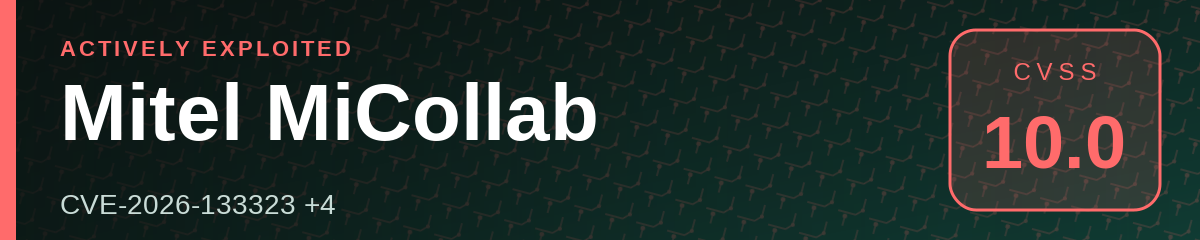
Mitel MiCollab: five AWV conferencing flaws exploited, attackers pivoted from the server into Active Directory
On 25 November 2026 CISA added five vulnerabilities in the Mitel MiCollab unified communications platform to its Known Exploited Vulnerabilities (KEV) catalog. All five sit in the Audio, Web and Video Conferencing (AWV) component and need no authentication. Mitel fixed them on 16 November, but according to Accenture attackers were already exploiting them the day before, and went on from the compromised server to domain controllers and databases.