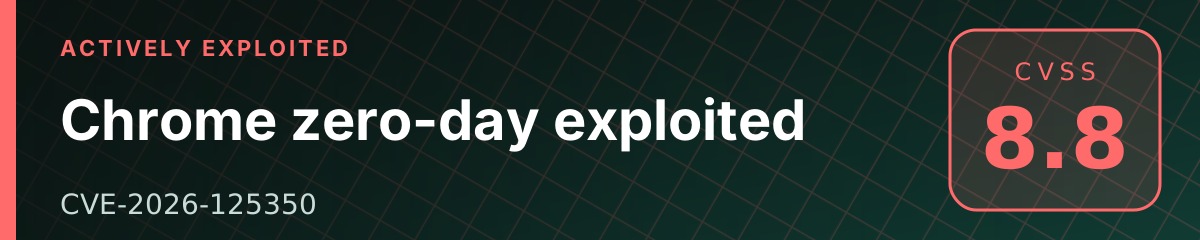
Actively exploited CVSS 8.8 Security news
Chrome zero-day CVE-2026-125350 is being exploited – update to Chrome 157 now
Google released Chrome 157 on 9 November 2026 and says an exploit for one of the fixed flaws, CVE-2026-125350, already exists in the wild. If you use or manage Chrome, make sure it has updated and restarted.
Key points
- CVE-2026-125350 is a high-severity use-after-free in Chrome's XML component. Google states that it is aware an exploit for it exists in the wild.
- The fix is in Chrome 157.0.8103.50/.51 for Windows and Mac, 157.0.8103.50 for Linux, Extended Stable 156.0.8078.96 and Chrome 157.0.8103.50 for Android.
- The flaw was reported anonymously on 6 November 2026 and patched three days later. Google keeps the bug details restricted, so there are no technical details or indicators of compromise yet.
- Update Chrome and restart it. Admins should check their fleet's version, and users of other Chromium-based browsers should watch for their own vendor's update.
Vulnerabilities: CVE-2026-125350
What happened
On 9 November 2026 Google promoted Chrome 157 to the Stable channel: version 157.0.8103.50/.51 for Windows and Mac and 157.0.8103.50 for Linux. The release fixes nine security flaws. Google's bulletin singles out one of them: "Google is aware that an exploit for CVE-2026-125350 exists in the wild."
That makes CVE-2026-125350 a zero-day – a flaw attackers had a working exploit for before most users had the fix. The same day Google shipped it in the Extended Stable channel (156.0.8078.96 for Windows and Mac) and in Chrome 157.0.8103.50 for Android. Google says the update will roll out "over the coming days/weeks", so some computers won't have it yet.
| Item | Value |
|---|---|
| Flaw | CVE-2026-125350 – use after free in XML |
| Severity (Google) | High |
| Exploitation | an exploit exists in the wild (Google) |
| Reported | anonymously, 6 November 2026 |
| Fixed | 9 November 2026 – Chrome 157.0.8103.50 |
| CVSS score | 8.8 (CVSS 3.1, CISA's rating in NVD) |
Technical details
Google describes the flaw in four words: use after free in XML. A use-after-free happens when a program frees a block of memory but keeps using a pointer to it. If an attacker manages to put their own data in that freed memory, the program then works with data the attacker controls. In browsers this class of bug is a common route to running code inside the renderer process, the sandboxed part of Chrome that processes web pages.
The XML component handles parsing of XML documents that a page loads or builds. In a typical browser attack, the victim only has to open a malicious page or a legitimate site that has been compromised; no download or click on a file is needed. Real-world attack chains often combine a renderer bug like this one with a second flaw to escape the sandbox. Google hasn't said whether that's the case here.
Google keeps bug reports restricted "until a majority of users are updated with a fix", so it hasn't published the exact affected code, the conditions for exploitation or how the attacks work. We don't publish exploitation details either.
The other fixes in Chrome 157 include high-severity flaws in WebGL, FileSystem, Compositing, GPU and V8 and a second use-after-free in XML (CVE-2026-125346). Google doesn't report any of them as exploited.
Who is affected
- Google Chrome on Windows and Mac older than 157.0.8103.50/.51, and on Linux older than 157.0.8103.50.
- Extended Stable (used by organisations that update every eight weeks) older than 156.0.8078.96.
- Chrome for Android older than 157.0.8103.50. Google says Android releases contain the same security fixes as the matching desktop release unless noted otherwise.
- Other Chromium-based browsers (Microsoft Edge, Brave, Opera, Vivaldi and others) may share the vulnerable code. Each vendor ships the fix in its own update.
- Microsoft Edge: in its Edge security release notes on 9 November, Microsoft wrote that it is aware of recent exploits in the wild and is actively working on a fix. The entry doesn't name a CVE. The latest Stable Edge, 157.0.4341.42, shipped on 5 November, before the Chromium fix. According to Microsoft, Edge for Android 157.0.4341.53 (11 November) fixes the bug; desktop Edge had no fix as of the morning of 12 November; as of 14 November Microsoft lists the fix in version 157.0.4341.46 (see Updates).
How to tell if you were compromised
Google hasn't published any indicators of compromise – no domains, IP addresses or file hashes – and hasn't said who was targeted. With browser zero-days, attacks are often aimed at a small group of people, so most users won't notice anything.
What admins can do:
- Find outdated browsers. Use your endpoint management or software inventory to list devices running Chrome older than the versions above.
- Check for unexpected child processes of Chrome in your EDR, such as command shells, PowerShell or script interpreters started by a browser process.
- Watch for new indicators. If Google, another vendor or CERT publishes indicators later, you can pull them out of their report in our IOC extractor, which runs only in your browser.
What to do
- Update Chrome and restart it. Go to Menu → Help → About Google Chrome. The update finishes only after a relaunch – a browser with dozens of open tabs that hasn't been closed for weeks is still vulnerable.
- On Android, update Chrome from Google Play.
- Admins: push version 157.0.8103.50 (or 156.0.8078.96 on Extended Stable), or better the newer 157.0.8103.78 with further fixes, and enforce a relaunch through policy. Don't wait for the gradual rollout.
- Edge and other Chromium browsers: update desktop Edge to 157.0.4341.46 or later (currently 157.0.4341.57) and Edge for Android from Google Play to 157.0.4341.53 or later. For other Chromium-based browsers, install the vendor's next security update and check its release notes for CVE-2026-125350.
- Check again in a few days. We'll add technical details to this article once they're published.
Timeline
Updates
- 14 November 2026 – Desktop Edge is patched. Microsoft has replaced the text of its 9 November Edge security release notes entry (previously "aware of exploits, working on a fix"): it now says Edge Stable 157.0.4341.46 contains the fix for CVE-2026-125350. The entry doesn't say exactly when that build shipped – it wasn't listed on the morning of 12 November. On 13 November Microsoft followed with Edge 157.0.4341.57, which picks up further Chromium security fixes (CVEs to be added). Google has meanwhile released Chrome 157.0.8103.78: since 11 November the NVD has dozens of new records fixed in that version, at least three rated Critical by Chromium (including use-after-free bugs in ServiceWorker and Layout). None of them is marked as exploited. We recommend updating straight to that version.
- 12 November 2026 – Microsoft added an 11 November entry to its Edge security release notes: Edge for Android 157.0.4341.53 contains the fix for CVE-2026-125350, which the Chromium team reports as exploited in the wild. No patched Stable build for desktop Edge (Windows, Mac, Linux) had shipped by the morning of 12 November – the latest is still 157.0.4341.42 from 5 November. There is still no technical write-up or indicators of compromise.
- 11 November 2026 – Since the evening of 10 November, NVD has a record for CVE-2026-125350 (status "Analyzed"): weakness CWE-416 (use after free), affecting Chrome before 157.0.8103.50. CISA scored it 8.8 under CVSS 3.1 (
AV:N/AC:L/PR:N/UI:R/S:U/C:H/I:H/A:H) – exploitable over the network with no login, as long as the victim opens a crafted page – and lists exploitation as active. As of the evening of 11 November, Microsoft still hadn't shipped the Edge fix for desktop (its latest entry, from 9 November, says it is working on one). No technical write-up or indicators of compromise have been published. - 10 November 2026, evening – CISA added CVE-2026-125350 to its Known Exploited Vulnerabilities (KEV) catalogue; US federal agencies must patch by 24 November 2026. There is still no CVSS score and no technical write-up. For Edge on desktop, Microsoft still says it is working on a fix.
- 10 November 2026, morning – Microsoft said on 9 November that it is aware of in-the-wild exploits and is preparing an Edge fix; none had shipped by the morning of 10 November. Still no NVD record or CISA KEV listing (KEV 2026.11.09). Google hasn't posted anything new on Chrome since 9 November.
- 10 November 2026 – first version of the article.
FAQ
How do I check that my Chrome is patched?
Open the menu, then Help → About Google Chrome. Chrome checks for updates and asks you to relaunch. The version should read 157.0.8103.50 or later (on Windows and Mac also .51), or 156.0.8078.96 or later if your organisation uses Extended Stable.
Does this affect Edge, Brave, Opera or Vivaldi?
They are built on Chromium, the open-source project behind Chrome, so they may contain the same code. Google's bulletin covers only Chrome. Microsoft said on 9 November that it is aware of recent in-the-wild exploits and is working on an Edge fix. On 11 November it shipped a fixed Edge for Android, 157.0.4341.53, and as of 14 November it lists the fix in desktop Edge 157.0.4341.46. Install your browser's next security update and check its release notes for CVE-2026-125350.
What about Chrome on iPhone?
Google's 9 November posts don't mention iOS. Chrome on iPhone and iPad has traditionally been built on Apple's WebKit engine rather than Chromium's, so it's unclear whether it's affected. Keep both iOS and the Chrome app up to date.
Who is behind the attacks?
Google hasn't said. Its bulletin only confirms that an exploit exists in the wild. The flaw was reported anonymously, and Google hasn't named the targets or the attacker.
Sources
- Google Chrome Releases – Stable Channel Update for Desktop (9 November 2026)
- Google Chrome Releases – Extended Stable Update for Desktop (9 November 2026)
- Google Chrome Releases – Chrome for Android Update (9 November 2026)
- Microsoft Learn – Release notes for Microsoft Edge Security Updates (9 November 2026)
- Google Chrome Help – Update Google Chrome
- CISA – Known Exploited Vulnerabilities Catalog (CVE-2026-125350; added 10 Nov 2026)
- NVD – CVE-2026-125350
Spotted a mistake? Let us know and we will correct it openly.
Related
Critical
Firefox 160 fixes 99 flaws, 57 rated high and nine sandbox escapes - update ESR too
Mozilla shipped Firefox 160 on 10 November 2026, along with Firefox ESR 153.7 and 115.45. The Firefox 160 advisory alone lists 99 vulnerabilities, 57 of them rated high. Mozilla describes nine of those as sandbox escapes, meaning flaws that can break the isolation meant to keep a malicious page away from the operating system. There are no reports of exploitation so far. Here is what to update and how to check it across a fleet.
Actively exploited
ScreenConnect attacks on managed service providers: ConnectWise disables RMM+ extensions
Late on 11 November 2026 ConnectWise said it is investigating unauthorized access to certain partner ScreenConnect environments, mostly managed service providers (MSPs). Its working theory is that attackers abused third-party extensions from the RMM+ family, which can run remote commands, and used them to push their own remote-access clients into customer networks. ConnectWise says it has found no vulnerability in ScreenConnect itself.
News
SignDrop: public exploit for an unpatched Windows CLFS driver flaw grants SYSTEM privileges
On 12 November 2026 researcher Abdelhamid Naceri (Nightmare Eclipse) published a proof-of-concept exploit called SignDrop on GitHub. It abuses a flaw in the Common Log File System driver (clfs.sys) – specifically in the protection Microsoft added to CLFS because of earlier attacks. According to the author, a standard user or malware on the machine can gain SYSTEM privileges. There is no fix, no CVE and no statement from Microsoft yet. Here is what it means for Windows admins.